How to preserve autographs: 9 keys to protecting them
How to handle, store, display and digitise signed letters and documents without damaging them, and how to keep their provenance, photographs and certificate together.
Contents
Knowing how to preserve autographs means protecting two things: the physical document and the information that goes with it. A signature can remain visible while the envelope that explained its provenance, the purchase invoice or the photographs taken before some damage are lost. A well-preserved collection looks after both.
If you have just bought a signed letter or found family documents, do not start by restoring them. The first step is to look at their condition, prepare a suitable place and record what you know. An unnecessary intervention can complicate preservation and also any later authenticity examination.
This guide deals mainly with autographs on paper; signed photographs, books or objects may need different care. The recommendations are based on the preservation guidance of the US Library of Congress and National Archives; the record sheets and organisational examples are my own practical suggestions.
1. What to do when an autograph arrives home
Before opening a parcel, clear the table and prepare a place to rest the document. Photograph the packaging if it is damaged and keep the purchase documentation.
Record the condition of the item without handling it more than necessary: an overall photograph of the front and, if there is no risk, of the back. Do not try to correct a crease, a stain or a folded corner straight away.
Assign your own reference, for example AUT001, on the record sheet and on the folder, never on the item. If the document already has a catalogue or certificate number, keep that too. Months later, that dated description will tell you whether a tear was already there when you bought the letter.
2. Handle paper with support and the right hands
The National Archives recommend washing your hands and not applying hand cream before touching paper, which can be handled without gloves, because gloves make delicate sheets harder to handle. They do, however, advise wearing gloves for photographs and negatives, as fingerprints can leave permanent marks.
So identify the support before touching it. A signed photograph is not treated the same way as a letter, and brittle paper does not tolerate the same handling as a modern sheet in good condition.
Always move the item on a rigid support, never dangling from a corner, and work on one item at a time, with its folder and record sheet in view. That way you will avoid mixing up envelopes, certificates or photographs.
3. Choose archival folders and boxes
The National Archives recommend board or card containers that are lignin-free and acid-free or alkaline-buffered, sized so that the item lies flat or stands upright without bending or shifting. If a letter is larger than the folder, change the folder: do not add a new fold.
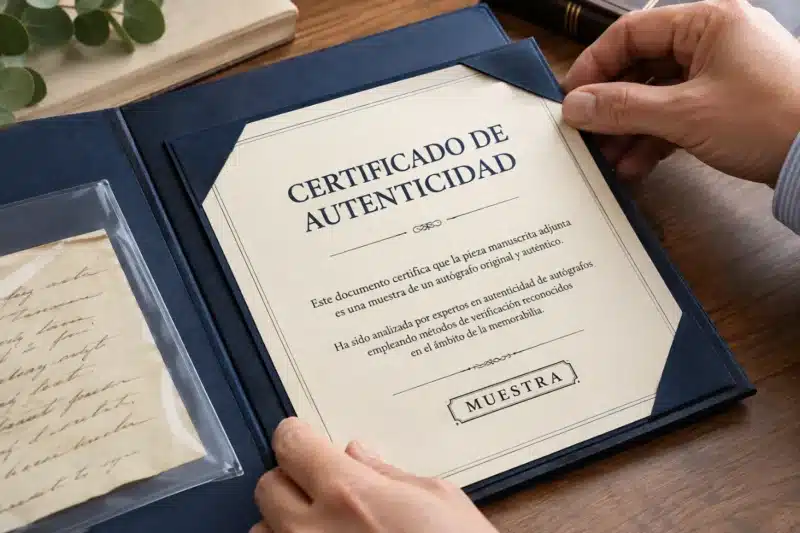
For brittle, torn or frequently consulted papers, the same institution suggests L-shaped polyester sleeves, one item per sleeve and always larger than the document. Avoid unknown plastics and PVC, as well as self-adhesive "magnetic" albums. If the ink or pigment is flaking, seek advice before using sleeves: static electricity from some plastics can lift the medium.
When buying materials, note the dimensions of the object and ask the supplier about their composition. A "premium" or "collector's" label does not in itself describe the properties of the material.
LOOKING FOR AN ORIGINAL SIGNATURE?
Explore the collection of autographs, signed documents and selected historical items at Autographs & Militaria.
4. Find a stable environment and reduce household risks
The National Archives advise storing documents away from damp basements, garages and hot attics, away from pipes, windows or leaks, and on shelves, off the floor.
| Factor | National Archives guidance |
|---|---|
| Temperature | Below about 24 °C (75 °F): the cooler, the slower the deterioration. |
| Relative humidity | Below 65% to prevent mould. |
| Minimum humidity | Not below 15%: paper becomes brittle. |
| Location | On shelving, away from water, food, insects and rodents. |
At home, start with the specific risks: a pipe above the cupboard, a damp wall, a window left open or a heat source. Changing the location is often more useful than buying an expensive box and leaving it in a bad spot. A thermo-hygrometer will help you spot changes.
Note in the inventory where each item is ("interior cupboard, top shelf") and record any move.
5. Display a reproduction and keep the original
All light, visible and ultraviolet, can fade or darken documents. The National Archives point out that the best protection is to display a copy and keep the original in a box; a good scan or a colour photocopy is fine for framing.
If you decide to display the original, they recommend glazing or acrylic with an ultraviolet filter, a mat or spacers so the glass does not touch the item, and acid-free mounting materials. Acrylic generates static electricity, so it is not suitable for pastels or other powdery media. A UV filter reduces the risk, but does not make indefinite display harmless.
Identify the reproduction in the inventory so nobody mistakes it for the collection item.
6. Avoid home repairs
Do not laminate the document, do not go over faded ink and do not use paper clips, rubber bands, adhesive tape or glue. Both the Library of Congress and the National Archives advise against these materials, which degrade, stain and are hard to remove.
If you find an old intervention, such as tape or adhesive, document it before doing anything and do not try to pull it off. For valuable or damaged items, consult a paper conservator.
Keep two kinds of consultation separate: authenticity and physical conservation. A forensic handwriting examiner studies the signature; a conservator assesses treatments for the support. Their roles complement each other, but they are not interchangeable.
7. Digitise for consultation, not to replace the original
The National Archives advise keeping originals after digitising them, because digital files carry their own risks. They advise against sheet-fed scanners for fragile, folded or valuable papers and warn that the scanner lid can crush an item that does not fit entirely.
Keep a full image and, where appropriate, separate details, with consistent names and no spaces: AUT001-front, AUT001-back, AUT001-signature. Add basic information (who, what, where, when) and keep the original capture separate from versions for social media.
For digital copies, follow the 3-2-1 rule: three copies, on two different media, one of them away from home. Check from time to time that the files still open.
A photograph does not capture all the properties of the object. The Aprende Grafología guide to the natural variation of signatures (in Spanish) explains why two images are not enough to settle every doubt.
8. Document provenance in an inventory
The invoice, the catalogue, the lot number or a message from the seller each provide different information. Do not reduce them to a sentence that erases their nuances. A simple record sheet might include:
| Field | What to record |
|---|---|
| Own reference | A stable code to locate the item. |
| Description | Type of document, number of sheets and visible features. |
| Date | The date on the item, noting any uncertainty. |
| Acquisition | Date of purchase or receipt and available documentation. |
| Stated provenance | What the seller or family says, with its source. |
| Certificate or report | Issuer, number, date and corresponding file. |
| Condition | Damage observed and dated photographs. |
| Location | Folder, box and storage place. |
Separate what is documented from what has been passed down orally and what is still to be checked. If a relative says the letter belonged to a particular person, keep that account with its attribution, without turning it into proven provenance.
The inventory does not certify authenticity. For that, see how to authenticate a signature and, if you are buying, how to buy an autograph safely.
9. Keep the item, images and certificate together
It is not enough to keep all the certificates in one folder and all the documents in another: there must be an unambiguous correspondence. Your internal reference links the document, its images and the certificate file. If you rename a photograph, update the record sheet; if you receive a new opinion, keep the previous one with its date.
If your item has a VS Certificate, you can check it in the certificate verifier. That check confirms the certificate, not the current state of preservation: the object may have changed since it was examined.
The same distinction between what a document claims and what it proves appears in other fields. The article on how to read a graphological report (in Spanish) applies it to personality reports, a field distinct from authenticity.
A simple routine for your collection
Review the collection box by box, without taking all the items out at once. Check that every reference has a record sheet, that the images open and that the noted location is still correct.
If you spot a change, describe it without diagnosing it: "a stain appears that is not visible in the previous photograph" is more accurate than attributing a cause. Note the date and ask whether it needs intervention.
Before a move or a loan, prepare an outgoing list and an incoming list. If someone else looks after your collection, leave them instructions for finding the files and avoiding improvised repairs.
Conclusion
Knowing how to preserve autographs reduces unnecessary handling, protects the history of the collection and better prepares any future examination. The signature is part of the document: looking after everything around it matters too.
Sources
- Library of Congress. Care, Handling, and Storage of Works on Paper.
- National Archives (NARA). Tips for Handling Family Papers and Photographs.
- National Archives (NARA). Storing Family Papers and Photographs.
- National Archives (NARA). Displaying Family Papers and Photographs.
- National Archives (NARA). Digitizing Family Papers and Photographs.
Frequently asked questions
Can I store a signed letter in any plastic sleeve?
No. Choose archival-quality polyester sleeves, larger than the item, and avoid PVC and unknown plastics. If the ink is flaking, seek advice before using a sleeve.
Do I need gloves to handle autographs on paper?
No. For paper, clean, dry hands without hand cream are enough; for photographs and negatives, gloves are recommended.
At what temperature and humidity should I store autographs?
As a household guide, the National Archives recommend below about 24 °C and relative humidity under 65%, but not below 15%. What matters most is stability and avoiding basements, garages and attics.
Does UV-filtering glass prevent all deterioration?
No. Visible light also causes changes. Displaying a reproduction and keeping the original is the safest option.
Can I fix a small tear with adhesive tape?
No. Self-adhesive tape degrades and stains paper. If the item needs treatment, go to a paper conservator.
Does preserving an autograph well prove that it is genuine?
No. Preservation, provenance and authenticity are related but different. A well-protected item may still need an authorship examination.
What should I do if I only have photographs of the autograph?
Keep the files without overwriting them and document their provenance. If you request an assessment, state clearly that you do not have the original.
Would you like to certify an autograph from your collection?
Send me a few photos and I'll tell you what certification costs. The preliminary assessment (€25) is deducted from the price of the certificate. Physical + digital or digital-only certificate, with a verifiable number. Service in English and Spanish.
Juan García Nicolás · Graphologist and forensic handwriting examiner
Trained at Ipsigrap, he personally signs every VS Certificate. Service in English and Spanish. More about me